Fanos is an educational platform delivering STEEP program lessons aimed at empowering Ethiopian adolescent girls with digital learning, STEM education, and preparation for national high school entrance exams. Supported by Global Affairs Canada and The Barrett Family Foundation.

Grade 11 Biology
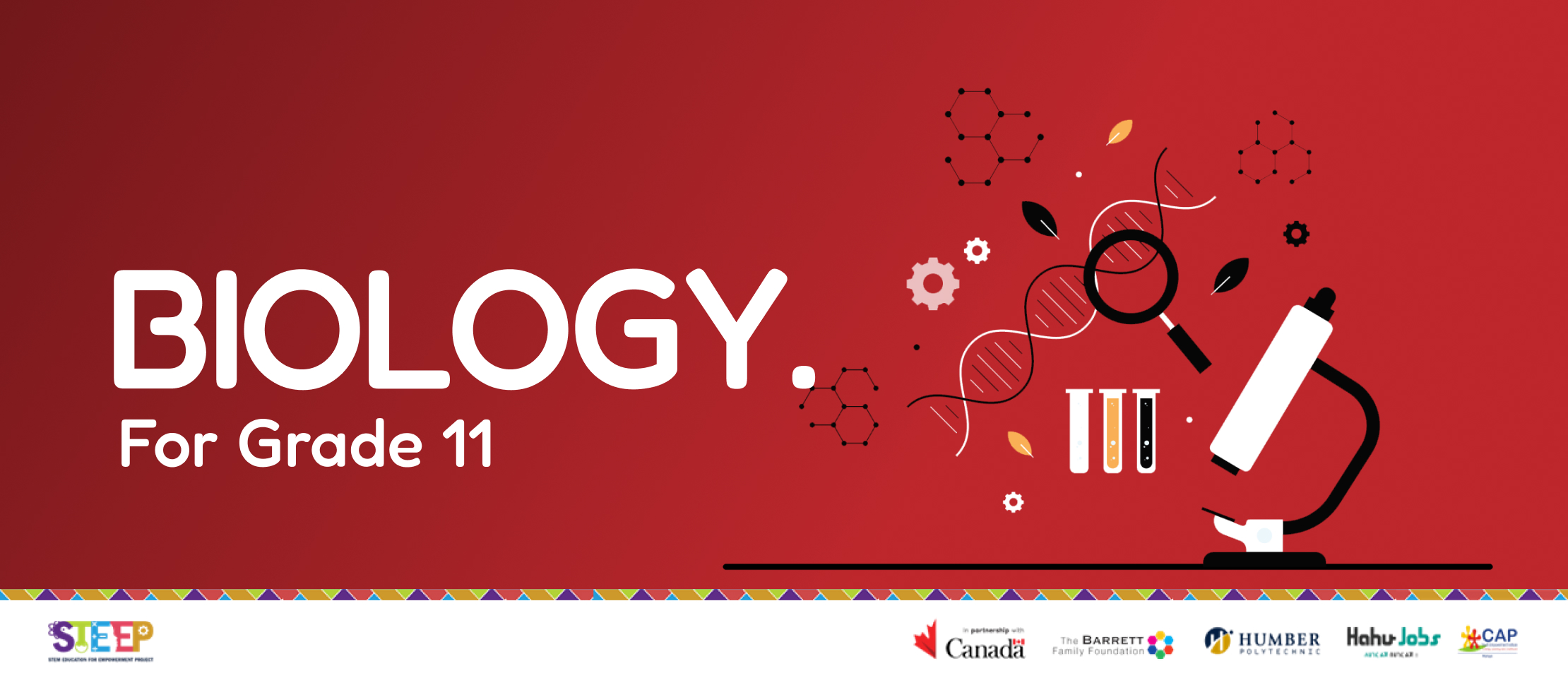

#Biology
In Partnership With


About the Course
Grade 11 Biology, structured under the Ethiopian national curriculum, gives students a broad and connected understanding of living things, the chemistry of life, inheritance, the human body and the environment. Theory is tied to laboratory activity and to locally relevant examples so that learners can apply biology to real problems.
The course is organised into six units that build on one another. Unit 1, Biology and Technology, shows how careful observation of nature inspires useful technologies (biomimicry) — from termite mounds guiding building ventilation to kingfisher beaks shaping bullet trains — and how technological tools such as microscopes, CT and PET scans and DNA analysis allow biologists to study life. Unit 2, Animals, describes the shared characteristics of animals, their classification into vertebrates and invertebrates, sexual and asexual reproduction, embryonic development and metamorphosis, the economic importance of insects, animal behaviour, and the homeostatic mechanisms (thermoregulation, osmoregulation and blood-sugar control) that keep internal conditions stable.
Unit 3, Enzymes, explains how protein catalysts lower activation energy and drive metabolism, how protein structure determines enzyme function, how temperature, pH and inhibitors affect activity, and how enzymes are used in industry and in traditional Ethiopian malting for drinks such as Tella and Tej. Unit 4, Genetics, introduces the structure and function of DNA and RNA, DNA replication, mitosis and meiosis, protein synthesis through transcription and translation, and the patterns of Mendelian and non-Mendelian inheritance, including ABO and Rh blood groups and sex-linked traits.
Unit 5, The Human Body Systems, studies the musculoskeletal system that supports and moves the body and the reproductive system that ensures continuity of the species, then applies this knowledge to reproductive health, harmful traditional practices, family planning and the effects of alcohol, Khat and other drugs. Unit 6, Population and Natural Resources, examines how populations are measured and regulated, the difference between renewable and non-renewable resources, the environmental problems caused by human activity, and the conservation strategies — including Ethiopia's indigenous practices and the Green Legacy initiative — that protect the environment for future generations.
Who should learn this course?
- Students interested in health, science and technology careers
- Learners curious about how living systems and the human body work
- Those interested in genetics, the environment and conservation
What you will learn?
- Grade 11 Biology helps you understand how living things work and how biology connects to technology, health and the environment.
- Biology & Technology: See how nature inspires invention and how tools extend biological study.
- Animals & the Human Body: Learn how animals reproduce and how the body moves and stays balanced.
- Genetics: Understand how DNA stores information and how traits are inherited.
- Environment: Explore populations, conservation and Ethiopia's natural resources.
What is required to learn this course?
- Background: Grade 9 and Grade 10 Biology and basic chemistry
- Math Skills: Simple arithmetic and ratios for genetics and population estimates
- Technology: Access to a computer or tablet
- Materials: Lab notebook and a scientific calculator
Ready to Update Your skills?
- Course Duration2 hours 59 minutes
- Gradegrade 11
- Course Typeonline
Reviews
Good