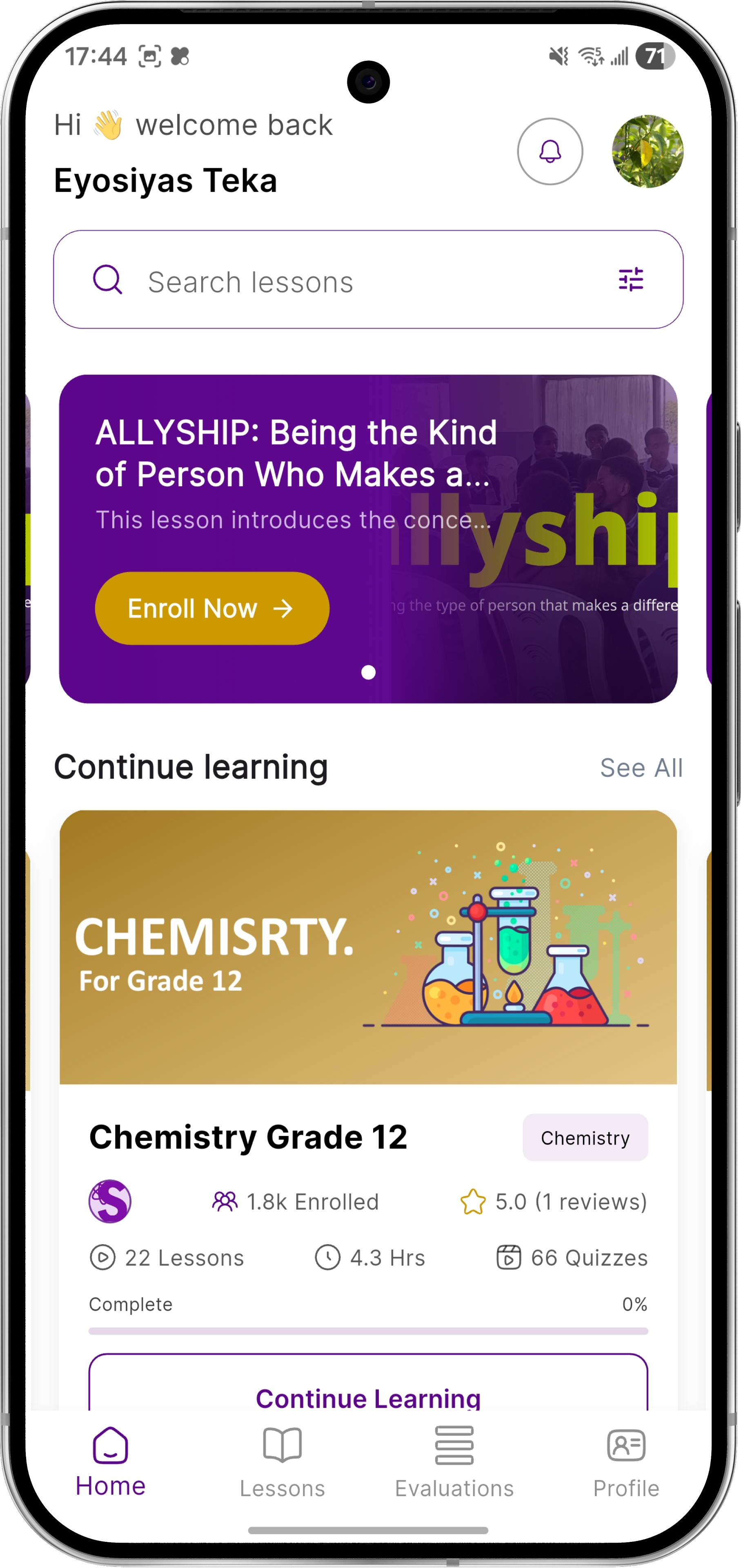
Fanos is an educational platform delivering STEEP program lessons aimed at empowering Ethiopian adolescent girls with digital learning, STEM education, and preparation for national high school entrance exams. Supported by Global Affairs Canada and The Barrett Family Foundation.

ICT Grade 12


#ICT
In Partnership With


About the Course
The Grade 12 ICT course is meticulously structured to build both theoretical understanding and practical proficiency in information and communication technologies over six progressive units, ensuring a coherent learning journey from foundational concepts to advanced applications. It begins with an exploration of the societal, ethical, legal, environmental, and health dimensions of information systems, laying the groundwork for students to critically evaluate technology’s impact on individuals and communities.
Subsequent units delve into emerging technologies such as artificial intelligence, cloud computing, and mobile platforms, offering learners insight into contemporary trends that are reshaping the ICT landscape. The database management unit emphasizes relational database design, SQL querying, and normalization techniques, enabling students to model, implement, and manipulate data effectively. In the web authoring section, pupils master HTML, CSS, and introductory JavaScript, culminating in the development and deployment of responsive web pages that illustrate both aesthetic and functional considerations. The maintenance and troubleshooting unit equips learners with best practices in hardware servicing, software diagnostics, and network administration, fostering technical autonomy and problem‑solving acumen. Finally, the programming fundamentals unit introduces algorithmic thinking through Python, covering variables, control structures, functions, and basic data structures to prepare students for more advanced coding challenges. Throughout, the curriculum interweaves case studies, collaborative projects, and hands‑o The digital Grade 12 ICT curriculum is organized into six comprehensive modules that directly reflect the core lessons of the printed textbook ranging from ethical, legal, social, environmental, and health issues in information systems to Python programming fundamentals while leveraging multimedia, adaptive assessments, and collaborative tools to engage learners in a self‑paced, interactive environment.Students move sequentially through discrete lesson topics such as Intellectual Property, Digital Identity Management, Big Data applications, SQL query design, XML/HTML authoring, system maintenance utilities, and Python flow controls mirroring the detailed subunit structure in the national curriculum.
Every lesson is augmented with concise video lectures, hands‑on virtual labs, and automated formative quizzes that provide instant feedback and targeted remediation The platform supports offline learning via PDF/video downloads in a dedicated Android app, ensuring continuity even in low‑connectivity settings. Cloud‑based collaborative documents and moderated discussion forums accompany each lesson, fostering teamwork on real‑world case studies like e‑government workflows or IoT implementations.
Who should learn this course?
- Grade 12 students in Ethiopia aiming to enhance their ICT competencies.
- Students interested in pursuing further studies or careers in technology, science, engineering, or related fields.
- Individuals seeking to become informed and responsible digital citizens.
- Learners who wish to leverage technology for personal growth and community development.
What you will learn?
- To acquire essential ICT knowledge and skills relevant to academic and professional settings.
- To understand the ethical, legal, social, environmental, and health implications of information systems.
- To explore emerging technologies such as Big Data, cloud computing, fog computing, and the Internet of Things (IoT).
- To gain proficiency in database management, web authoring, system maintenance, troubleshooting, and programming fundamentals.
- To prepare for further studies or careers in technology-related fields.
What is required to learn this course?
- Basic understanding of computer operations and applications.
- Prior exposure to ICT concepts covered in earlier grades, particularly Grade 11.
- Access to a computer or computing device for practical exercises.
- Willingness to learn and adapt to new technological tools and concepts.
Ready to Update Your skills?
- Course Duration3 hours 27 minutes
- Gradegrade 12
- Course Typeonline
Reviews

there is no any Review Available for this course yet!