Fanos is an educational platform delivering STEEP program lessons aimed at empowering Ethiopian adolescent girls with digital learning, STEM education, and preparation for national high school entrance exams. Supported by Global Affairs Canada and The Barrett Family Foundation.

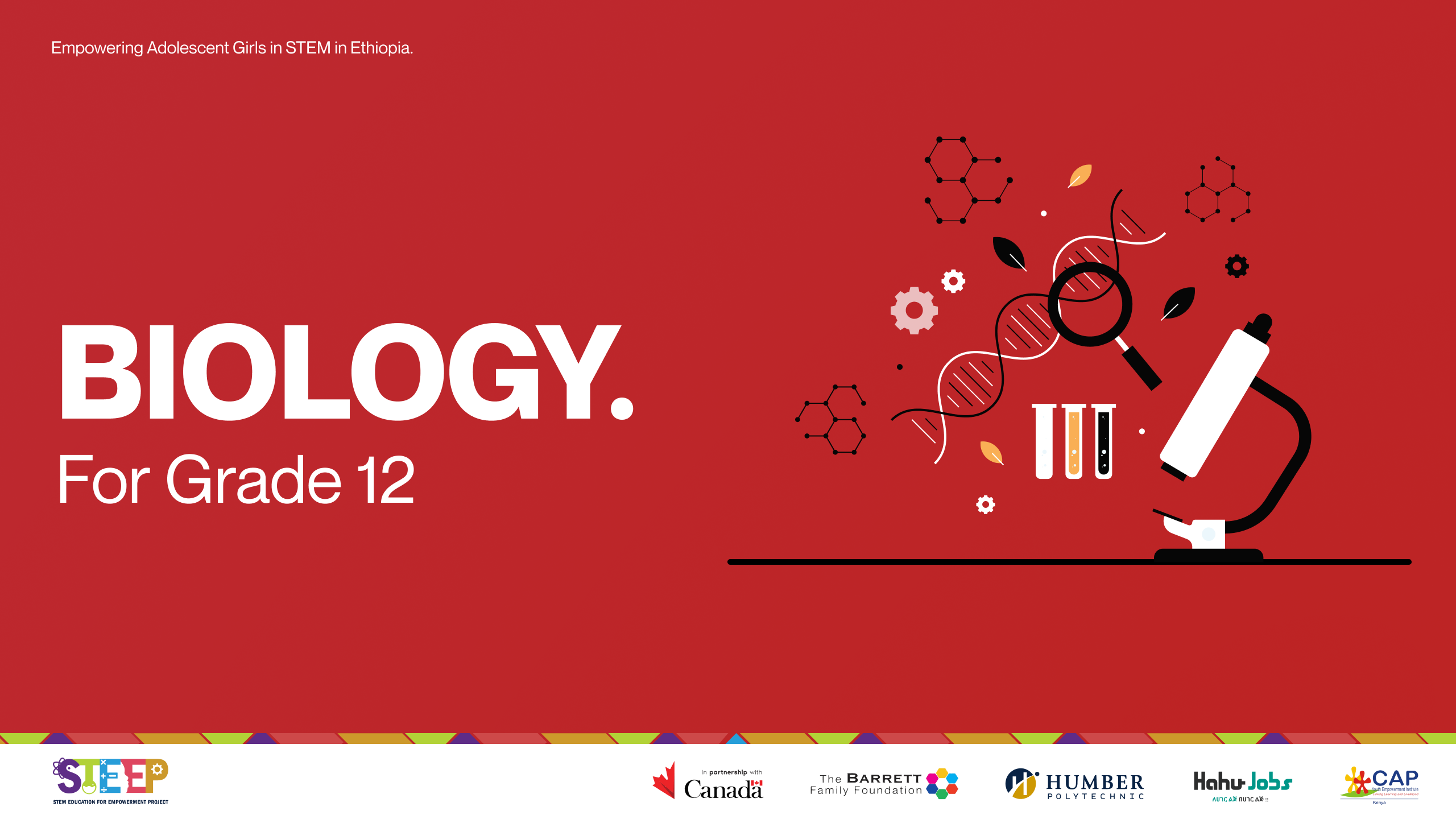
Grade 12 Biology

#Biology
In Partnership With


About the Course
Grade 12 Biology, as structured under the new Ethiopian national curriculum, provides students with a comprehensive understanding of life processes, environmental interactions, and practical applications of biological knowledge. The course integrates theoretical concepts with locally relevant examples, laboratory activities, and problem-solving exercises that prepare learners for higher education, scientific careers, and informed citizenship.
The course is organized into six interconnected thematic units, each building on prior knowledge and demonstrating the relevance of biology to Ethiopian society and ecosystems. The first unit, Applications of Biology, introduces students to the role of biology in solving real-world challenges, such as sustainable agriculture, food security, and conservation. Lessons emphasize strategies like in-situ and ex-situ conservation, the management of renewable and non-renewable resources, and practical applications of biotechnology, including GMOs, antibiotic production, DNA profiling, and biomining. Local examples, such as the conservation of Ethiopia’s wild coffee and the use of Thiobacillus ferrooxidans in mining, contextualize learning and highlight the country’s rich biodiversity.
Unit 2: Microorganisms guides students into the “invisible world” of life, emphasizing both its benefits and risks. Students explore Bacteria, Archaea, Fungi, Protozoa, and viruses, learning about microbial physiology, reproduction, and ecology. The unit highlights diseases relevant to Ethiopia, such as Malaria, HIV/AIDS, and Rabies, while contrasting harmful pathogens with normal human microbiota that protect health. Practical applications, such as fermentation, bioremediation, and the role of microbes in nitrogen fixation, link scientific knowledge to local agricultural and industrial contexts.
Unit 3: Energy Transformation (Bio-energetics) examines how life captures, stores, and uses energy. Students study photosynthesis in plants, comparing C3, C4, and CAM adaptations that allow species to thrive in diverse Ethiopian climates, including arid and semi-arid regions. Cellular respiration is explored at the biochemical level, covering glycolysis, the Krebs Cycle, and the electron transport chain, illustrating how energy stored in glucose molecules powers growth, movement, and metabolism. The unit culminates in the global energy balance, highlighting the interplay between photosynthesis and respiration in regulating atmospheric oxygen and carbon dioxide, and connecting cellular processes to ecological and planetary health.
Unit 4: Evolution investigates the mechanisms of genetic change, natural selection, and the evidence supporting common ancestry. The unit traces life’s evolutionary history from early theories of Lamarckism and Darwinism to the Modern Synthesis, integrating genetics and molecular biology. A strong emphasis is placed on human evolution in Ethiopia, the “Cradle of Mankind,” through pivotal fossil discoveries such as Lucy (Australopithecus afarensis) and Ardi (Ardipithecus ramidus). Students examine how adaptations like bipedalism and brain expansion shaped early humans, and explore molecular tools like the Molecular Clock to understand speciation and genetic variation. Local examples, including adaptations to malaria or lactose tolerance, provide tangible links between evolution and Ethiopian populations.
Unit 5: Human Body Systems explores the complex integration of the nervous, endocrine, and sensory systems in maintaining homeostasis. Students examine how neurons transmit signals, sense organs detect environmental stimuli, and hormones regulate long-term physiological processes. The unit emphasizes dynamic feedback mechanisms controlling thermoregulation, blood glucose, osmoregulation, and detoxification by the liver. Practical examples include the impact of substances like Khat and alcohol on homeostasis, and clinical relevance for public health awareness in Ethiopia.
Finally, Unit 6: Climate Change situates biology within a global context, analyzing the mechanisms and consequences of anthropogenic climate shifts. Students learn how greenhouse gases (CO₂, CH₄) and human activities exacerbate warming, particularly affecting Ethiopia’s rain-fed agriculture. The unit explores climate-induced disasters—droughts, floods, and locust outbreaks—and introduces students to international responses, including the Kyoto Protocol, UNFCCC, and Paris Agreement, alongside strategies for mitigation and adaptation. Local initiatives, such as Ethiopia’s Green Legacy reforestation program and climate-smart agriculture, reinforce practical engagement and societal relevance.
Who should learn this course?
- Students interested in health and science careers
- Learners curious about how living systems work
- Those interested in environment and biology-related challenges
What you will learn?
- Grade 12 Biology helps you understand how and why life works at cellular and system levels.
- Molecular Processes: Learn how respiration and photosynthesis sustain life.
- Genetics: Understand how DNA controls protein synthesis.
- Homeostasis: Explore how the body maintains internal balance.
- Career Skills: Build analytical and basic lab skills for science-related fields.
What is required to learn this course?
- Background: Grade 11 Biology and basic organic chemistry
- Math Skills: Simple algebra for genetics and enzymes
- Technology: Access to a computer or tablet
- Materials: Lab notebook and scientific calculator
Ready to Update Your skills?
- Course Duration4 hours 59 minutes
- Gradegrade 12
- Course Typeonline
Reviews
best

Nahom Ayele Desse
12th Grade Completed