Fanos is an educational platform delivering STEEP program lessons aimed at empowering Ethiopian adolescent girls with digital learning, STEM education, and preparation for national high school entrance exams. Supported by Global Affairs Canada and The Barrett Family Foundation.

Grade 9 Biology
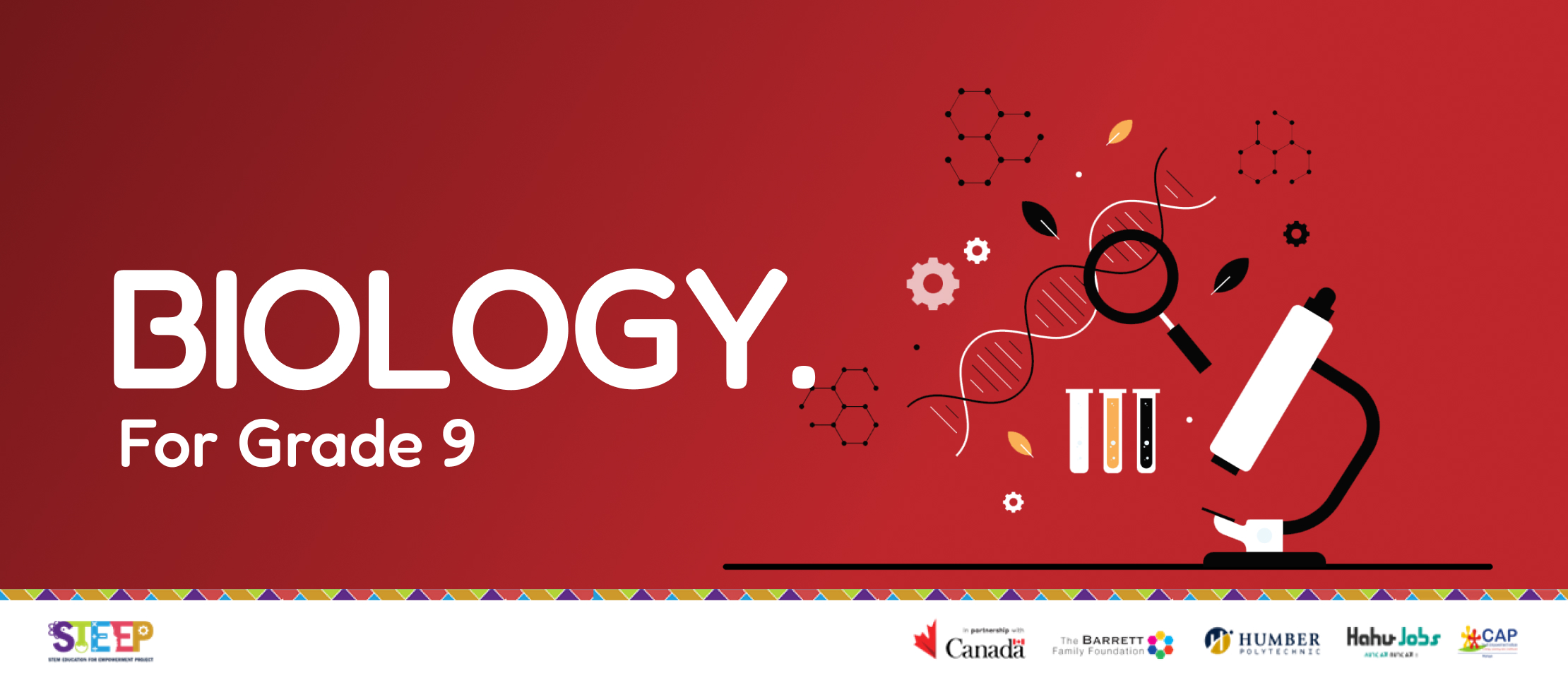

#Biology
In Partnership With


About the Course
Grade 9 Biology, structured under the Ethiopian national curriculum, gives students a broad and connected understanding of living things, from the smallest cell to the whole environment. The course is written for learners aged 13 to 15, so every idea starts with a clear definition in plain language before any list or detail, and each topic is linked to familiar Ethiopian examples.
The six units build on one another. Unit 1, Introduction to Biology, explains what biology is, why it is useful in medicine, farming, and daily life, and how the scientific method guides discovery. It then introduces the tools a biologist uses, the parts of the light microscope, and the rules that keep a laboratory safe. Unit 2, Characteristics and Classification of Organisms, describes the features shared by all living things and shows how scientists classify them into ordered groups, name them using the binomial system, and place them in the five kingdoms. Unit 3, Cells, studies the cell as the basic unit of life, its organelles and the cell theory, the differences between plant and animal cells, how materials move across the cell membrane by diffusion, osmosis, and active transport, and how life is organised from cells up to whole organisms.
Unit 4, Reproduction, explains how living things continue their species, comparing asexual and sexual reproduction, describing the human reproductive systems, the menstrual cycle, pregnancy, family planning, and how to protect reproductive health. Unit 5, Human Health, Nutrition, and Disease, covers food and the nutrients the body needs, the balanced diet, deficiency diseases, malnutrition, substance abuse, and the infectious and non infectious diseases common in Ethiopia. Unit 6, Ecology, brings the course together by studying how living things interact with each other and their environment, including biotic and abiotic factors, ecological levels, ecosystems, biomes, succession, and the relationships between species. Together the units build scientific literacy, practical skill, and a caring, informed attitude toward health and the environment.
Who should learn this course?
- Students interested in health, science, and technology careers.
- Learners curious about how the body and living things work.
- Those interested in nutrition, the environment, and conservation.
What you will learn?
- Grade 9 Biology helps you understand how living things work and how biology connects to your daily life.
- Life and cells: learn what living things are, and how the cell is the basic unit of life.
- Classification: understand how the huge variety of living things is named and grouped.
- Health and reproduction: learn how the body reproduces and how to eat well and stay healthy.
- Environment: explore how living things depend on one another and on their surroundings.
What is required to learn this course?
- Background: Grade 8 general science and basic reading.
- Maths: simple arithmetic and ratios for magnification and nutrition.
- Technology: access to a computer or a phone to watch the lessons.
- Materials: a notebook and a pen; a scientific calculator is helpful.
Ready to Update Your skills?
- Course Duration1 hour 37 minutes
- Gradegrade 9
- Course Typeonline
Reviews
arif new indeziw qexilubet

ISA
it is godd

Yididya
excellent

Iman Jilalu Nesru
11th Grade Completed