Fanos is an educational platform delivering STEEP program lessons aimed at empowering Ethiopian adolescent girls with digital learning, STEM education, and preparation for national high school entrance exams. Supported by Global Affairs Canada and The Barrett Family Foundation.

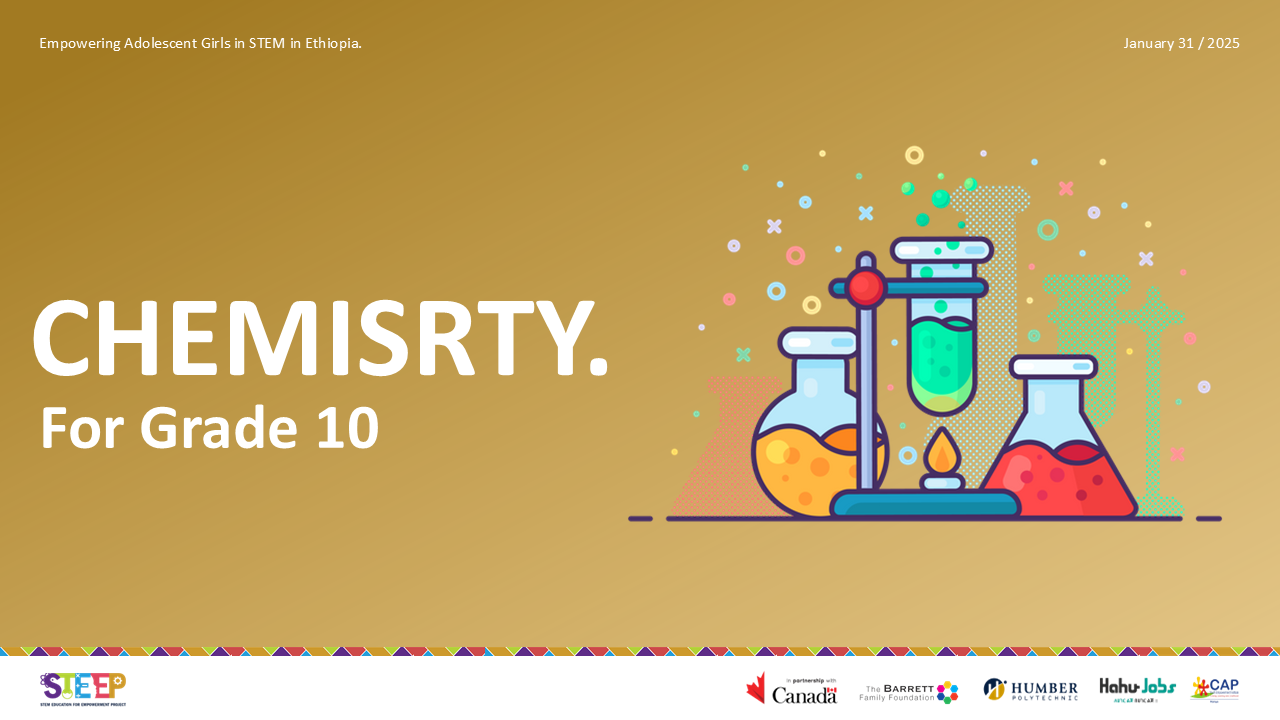
Grade 10 Chemistry

#Chemistry
In Partnership With


About the Course
This Grade 10 Chemistry course, structured around six key thematic units as defined by Fetena, guides students from the basics of chemical transformations to the complex behavior of organic molecules.It begins with a deep exploration of chemical reactions examining atom‐level rearrangements and energy changes to establish a robust understanding of how matter transforms and conserves mass From there, learners master the mole concept (SI unit for amount of substance), using it to quantify reactants and products and to perform stoichiometric calculations essential for accurate laboratory work.The course then transitions to solution chemistry, where students investigate solute solvent interactions, factors influencing solubility, and various concentration expressions (molarity, molality, percentage) before applying these concepts to prepare standard laboratory solutions. In the inorganic compounds unit, learners classify oxides, acids, bases, and salts, exploring their nomenclature, properties, and everyday applications from antacids to industrial catalysts.The energy changes and electrochemistry unit links thermodynamics to practical technologies, guiding students through enthalpy calculations, free‐energy considerations, and the design and interpretation of galvanic and electrolytic cells.Building on these foundations, the metals and nonmetals unit examines elemental properties, mineralogical sources, and metallurgical extraction methods such as smelting, refining, and electrolysis.Finally, the organic chemistry section introduces hydrocarbons, tracing their historical discovery, structural classification (alkanes, alkenes, aromatic compounds), isomerism, and characteristic reactions such as combustion and electrophilic substitution.Throughout the course, interactive digital modules, virtual lab simulations, and collaborative problem‐solving activities reinforce theoretical knowledge and develop practical skills critical for scientific inquiry.
Who should learn this course?
- Grade 10 Students.
- Self-Learners and Home-Schoolers seeking a comprehensive, step-by-step introduction to foundational chemistry concepts, this material assumes no prior university-level chemistry.
- Instructors and Tutors who need a clear outline of objectives and content to structure lesson plans, classroom demonstrations, and formative assessments for mid to late high-school students.
- Future STEM Majors in fields like biology, environmental science, engineering, nursing, or pharmacy who want to ensure they master stoichiometry, solution chemistry, acid–base behavior, and basic organic principles before advancing to higher-level courses.
What you will learn?
- To build a solid foundation in fundamental chemical principles,understanding how substances interact, transform, and release or absorb energy is essential for all branches of science and technology.
- To develop quantitative problem-solving skills (stoichiometry, concentration calculations, redox balancing) that are directly applicable to laboratory work, engineering, and everyday applications like cooking, cleaning, and environmental analysis.
- To gain insight into how chemistry underlies real-world phenomena—everything from how batteries power devices (electrochemistry) to why metals corrode, how fertilizers nourish plants (inorganic compounds), and how fuels are refined from crude oil (hydrocarbons).
What is required to learn this course?
- Completion of basic Grade 9 science (general concepts of matter, atoms, and simple chemical reactions) and comfortable working with arithmetic (fractions, ratios, percentages) and algebraic manipulations.
- Familiarity with the periodic table (names and symbols for common elements) and prior experience writing simple formulae; you should already know what an atom, molecule, and ion are.
- Access to a textbook or digital copy of the Grade 10 Fetena Chemistry Student Textbook (PDF) and a scientific calculator; for hands-on practice, a basic laboratory kit (test tubes, beakers, balance, thermometer, safety goggles) is recommended but not strictly required for conceptual learning.
Ready to Update Your skills?
- Course Duration5 hours 58 minutes
- Gradegrade 10
- Course Typeonline
Reviews
it is so useful and important and i recommend it to students since it is one of the most helpful website i have ever used

Abenezer Tadele Sileshi
11th Grade Completed
አንግሊዘኛ እና bio ይጨመር

Rediet Borkato
10th Grade Completed
It is nice

Blen Kiflu
9th Grade Completed