Fanos is an educational platform delivering STEEP program lessons aimed at empowering Ethiopian adolescent girls with digital learning, STEM education, and preparation for national high school entrance exams. Supported by Global Affairs Canada and The Barrett Family Foundation.

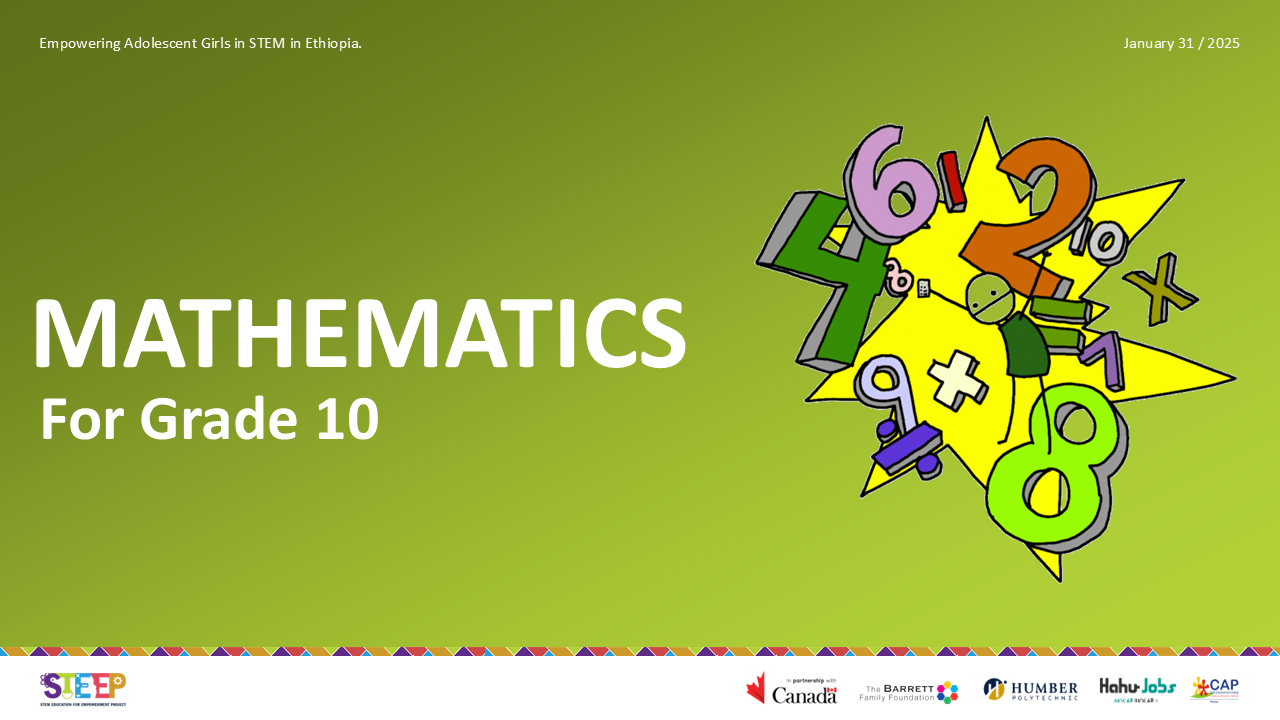
Grade 10 Maths

#Maths
In Partnership With


About the Course
This digital study resource for Grade 10 Mathematics is fully aligned with the Ethiopian Ministry of Education curriculum, It is designed to support both independent learners and classroom instruction through structured, interactive, and accessible digital content. The course is organized into seven units, six of which are covered here. Unit 1: Relations and Functions introduces foundational mathematical concepts including relations, functions, domain and range, and graphing in the Cartesian plane. It also covers different types of functions injective, surjective, and bijective using real-life patterns and mathematical logic. Unit 2: Polynomial Functions explores polynomial expressions and operations, key theorems, the behavior of graphs, and real-world applications such as modeling data with polynomial equations. Unit 3: Exponential and Logarithmic Functions develops students’ understanding of exponents and logarithms, their properties, equations, graphs, and practical applications, particularly in contexts involving growth and decay. Unit 4: Trigonometric Functions extends geometric reasoning to include radian measure, basic trigonometric ratios, identities, and equations, with practical applications in angle measurement and real-life problem-solving. Unit 5: Circles examines the geometric properties of circles, including symmetry, arc length, angles, and intersecting lines, encouraging the use of both algebraic and visual reasoning. Unit 6: Solid Figures focuses on three-dimensional shapes such as prisms, cylinders, pyramids, cones, and spheres, with emphasis on calculating surface areas and volumes and solving problems involving composite solids. Each unit contains clear learning objectives, guided activities, definitions, worked examples, exercises, summaries, and review questions. The chapter summaries highlight essential formulas and problem-solving techniques, making revision more efficient. This structured course scaffolds student learning from basic to complex mathematical concepts and concludes with a comprehensive course summary to support exam preparation and long-term retention. Optimized for digital delivery, the material enhances flexibility, engagement, and understanding in both remote and classroom learning environments.
Who should learn this course?
- Grade 10 Students following the Ethiopian national curriculum who seek a comprehensive, interactive guide to master each unit and excel in national examinations E-Learn
- Teachers and Tutors who need structured unit outcomes, chapter summaries, and review exercises to support lesson planning and differentiated instruction Fetena
- Self-Learners and Remedial Candidates aiming to reinforce algebraic and geometric concepts at their own pace using guided examples and end-of-unit assessments
What you will learn?
- Strengthens spatial reasoning via trigonometric functions, circle theorems, and three‐dimensional solids, essential for fields such as surveying, engineering, and architecture E-Learn
- Integrates coordinate geometry to bridge algebra and geometry, laying the groundwork for analytic geometry and STEM disciplines
- Fully aligned with the Ethiopian Ministry of Education’s Grade 10 mathematics curriculum, ensuring you cover all required competencies for national exams E-LearnBuilds on Grade 9 foundations in algebra and geometry to introduce advanced topics relations, functions, and their graphical representations critical for higher‐level mathematics E-Learn
- Develops robust problem‐solving skills through polynomial, exponential, and logarithmic functions, equipping you to model real‐world phenomena like growth, decay, and data trends E-Learn
What is required to learn this course?
- Completed Grade 9 Mathematics, with proficiency in basic algebraic manipulation, linear equations, and introductory geometry Ethiopia Learning.
- Access to the Grade 10 Mathematics digital textbook at STEEP lab in respective school compounds.
- A scientific calculator capable of evaluating exponents, logarithms, and trigonometric functions Ethiopia Learning
Ready to Update Your skills?
- Course Duration6 hours 39 minutes
- Gradegrade 10
- Course Typeonline
Reviews
it's good

Meryem Sefa
I don't have any experience

Abdurre Kedir
በጥሩ መንገድ ነው የምታስተምሩት ይበልጥ ደግሞ የተለያዩ ጥያቄዎቺን እየሰራቺሁ ብታስተምሩ

Rediet Borkato
10th Grade Completed